
Live Oak Projected Release Dates
TDCJ uses “Projected Release Date” as a defined field. CID Classification and Records calculates it for a current state prisoner based on the offense title, offense date, sentence, credits, and mandatory-supervision rules. It is the projected date of release from incarceration if parole does not occur first. It is not the same as a parole eligibility date, a Board vote, or proof that release took place.
A Scheduled Release Date and location may appear after TDCJ schedules the release. Even that date can change without notice while staff audit certificates, sentence calculations, program completion, and an approved residence. The actual release or discharge record is the documentary endpoint. For a person in the Live Oak County Jail before trial, there may be no calculated sentence date because bond, dismissal, plea, trial, holds, and court orders remain unresolved.
- Eligibility date
- The earliest point at which the law permits parole review, not a promise of release.
- Projected Release Date
- TDCJ's calculated estimate for release from incarceration if parole does not happen first.
- Scheduled Release Date
- An operational date posted after scheduling, still subject to change.
- Discharge
- The sentence endpoint documented by the agency responsible for the sentence.
Find Live Oak Projected Release
Classify the custody system before searching. The Live Oak County Jail holds local detainees and some sentenced people. TDCJ holds state prisoners. FCI Three Rivers and its satellite camp are federal facilities. Each system calculates and publishes dates differently, and a transfer between systems is not community release.
- Confirm the holding agency from the latest reliable custody event. Ask whether the person is in county, state, or federal custody.
- For TDCJ, open the official offender search. Use the exact last name plus at least a first initial, or a TDCJ or SID number.
- Open the detail result and record the Projected Release Date, maximum sentence date, location, and parole-review information exactly as shown.
- For Live Oak County Jail, call 361-449-2271 and request the sentence calculation or release sheet. Obtain the judgment and sentence-credit record from the proper clerk.
- For a federal prisoner, use the BOP Inmate Locator. Do not apply Texas good-time statutes to a federal sentence.
- Recheck near the date and request the final release or discharge record after the event.
The TDCJ online search covers only people currently incarcerated in a TDCJ facility. Its data is at least one day old and updates on working days. A missing former prisoner needs an email, telephone, or formal public-record request for historical release facts. A Live Oak arrestee who never entered TDCJ will not appear there.
Texas Projected Release Search Fields
The search page accepts a last name and at least a first initial, or a unique TDCJ or SID number. Last-name matching is exact. Similar names should be resolved with identifiers rather than assumptions. The detail page may show several milestones that sound alike but carry different legal and practical meaning.
| Field or milestone | What it establishes | What it does not establish |
|---|---|---|
| Parole eligibility date | Earliest statutory review point | Approval or release |
| Projected Release Date | TDCJ estimate under its calculation | A fixed gate date |
| BPP decision | Approval, denial, or another vote code | Completed release processing |
| Scheduled date and location | Operational release planning | An unchangeable outcome |
| Maximum expiration | Sentence endpoint under the applicable record | A generic synonym for every estimate |
| Actual release record | Recorded custody endpoint and disposition | Later supervision discharge |
The official TDCJ definitions show why the estimate can change. The captured definition page illustrates the terminology used for Texas state-prison calculations.
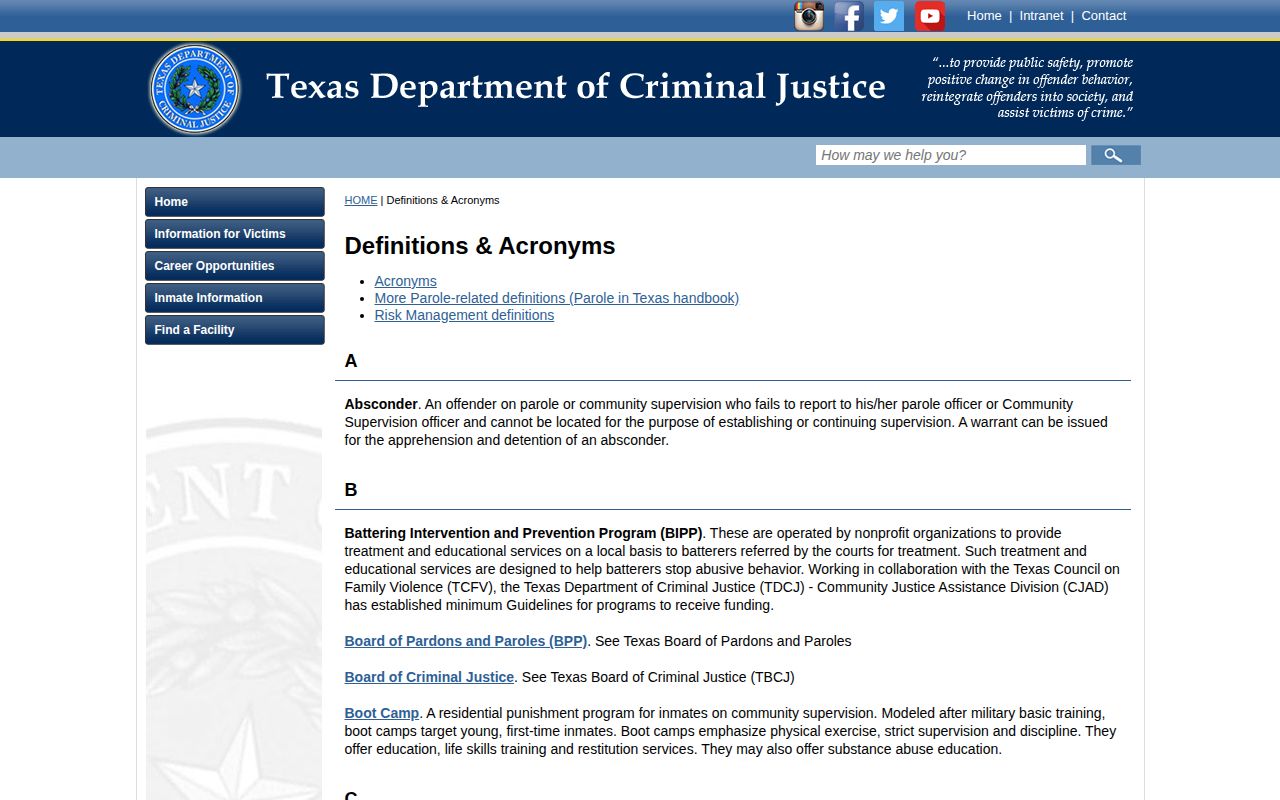
The image supports the state-prison route only. It does not calculate a date for a Live Oak County Jail detainee or a federal prisoner.
Live Oak Good-Time Rules
Texas has no blanket rule that every state prisoner serves 85 percent of a sentence. Eligibility depends on the offense, offense date, sentence, mandatory-supervision exclusions, flat-calendar thresholds, good-conduct class, and Board discretion. Government Code Sections 508.145 and 508.149 are key starting points. The controlling statute and the person's official TDCJ calculation matter more than a general percentage.
Government Code Section 498.003 provides that good-conduct time affects eligibility for parole or mandatory supervision and does not otherwise reduce the judicial sentence. Credit is a privilege. Classification, work or program participation, forfeiture, and restoration can alter it. Some serious offenses use flat-calendar minimums, with good time excluded from that eligibility formula. Death and life-without-parole sentences are not parole eligible.
The Texas good-conduct-time statute is the official source for the state rules.
This statute image provides the governing framework, but it should not be used to make an unofficial date calculation from a maximum earning rate.
Why Live Oak Release Dates Move
A projected date is a live administrative calculation. It can move after a legal decision, a record correction, discipline, or completion of a release condition. The system's own update lag can also make the visible date trail the agency's current record.
| Change | Possible effect | Confirmation source |
|---|---|---|
| Board grants or denies discretionary mandatory supervision | Denial may move the estimate to maximum expiration; later approval may move it earlier | BPP decision and TDCJ detail |
| Good-time class, loss, or restoration | Changes an eligible state-prison calculation | TDCJ Classification and Records |
| Court or sentence-credit correction | Moves the base calculation | Judgment, amended order, and agency record |
| New conviction, consecutive case, or detainer | Can prevent community release or extend custody | Court and receiving-agency records |
| Program, residence, or certificate review | Can delay operational scheduling | Parole Division or TDCJ release channel |
| Working-day data lag | Visible online date may be stale | Direct TDCJ inquiry |
Live Oak County Jail Credits
A county sentence uses a different framework from TDCJ. Texas Code of Criminal Procedure Article 42.032 permits a sheriff to grant commutation for good conduct, industry, and obedience within the statute's limit. It does not compel the Live Oak County Sheriff to grant the maximum credit in every case. Misconduct can lead to forfeiture. Article 42.01 addresses qualifying presentence confinement credit.
Ask the Sheriff's Office for its written good-time policy and the named person's existing calculation or release sheet. Pair that with the judgment from the proper court. A bond release is governed by bond and court authority, not by good-time computation. A pretrial detainee usually has no sentence from which to calculate a projected completion date.
The county-jail good-conduct statute shows the separate local authority.
The provision is a legal ceiling and grant of discretion, not proof of the credit entered in one Live Oak County sentence.
No Texas 85 Percent Rule
Live Oak release-date questions often cross systems because the county contains both a county jail and the FCI Three Rivers federal complex. Federal sentence credits follow federal law. Texas state-prison parole formulas follow Government Code Chapter 508. County-jail commutation follows Article 42.032. Combining those rules creates a false estimate.
TDCJ's projected date has three broad definition branches. Some older mandatory-supervision-eligible cases use flat time plus good time. Later eligible cases also require Board approval for discretionary mandatory supervision. If approval is denied, the estimate may become the maximum-expiration date. Noneligible cases generally reach maximum expiration through flat time. The offense date and legal classification decide the branch.
This is the distinctive Live Oak computation issue: no single percentage can safely cross state prison, county jail, and federal custody. Obtain the agency's own date and then confirm the final event.
Confirm Live Oak Actual Release
Near a predicted date, ask whether TDCJ has posted a Scheduled Release Date and location. In a parole-in-absentia case, where the person remains in a county jail, CID Records may not post a scheduled date online. The Parole Division's Huntsville review and release channel is then the better source. Board approval can still carry program or residence conditions.
For a county case, request the Live Oak jail custody log, booking and release sheet, and the court order that authorized the disposition. Texas IVSS-Counties may send a participating county event alert, while TDCJ IVSS handles prison and parole events. The Live Oak VINELink and IVSS search route explains those separate notices. An alert is useful, but the final agency record establishes the actual date, type, and any transfer destination.